
Required in Djibouti
The Djibouti Ports and Free Zones Authority (DPFZA) requires the ECTN for cargo discharged in Djibouti. You may also see it called the Djibouti CTN.
We prepare and file the Djibouti ECTN (also called CTN) for your shipments to the Port of Djibouti. Send your B/L draft, approve the ECTN draft within minutes, and receive the validated certificate.
The ECTN is required for cargo discharged at the Port of Djibouti, whether it is cleared in Djibouti or enters the Djibouti Free Zone.
The Djibouti Ports and Free Zones Authority (DPFZA) requires the ECTN for cargo discharged in Djibouti. You may also see it called the Djibouti CTN.
Each Bill of Lading needs its own ECTN. A split or reissued B/L needs a new certificate.
Cargo sent straight on to Ethiopia does not need an ECTN when the B/L shows “In transit to Ethiopia” and the consignee is in Ethiopia. Cargo cleared in Djibouti or entering the Free Zone does.
Send us your B/L draft and invoices. We prepare the ECTN draft, file it after your approval and send you the validated certificate.
These are the documents we need to apply for the ECTN for your shipment to Djibouti.
A draft B/L is enough to start. We use it to prepare the application and update it once the final B/L is issued.
Shows the value and description of the goods, matching the cargo declared on the B/L.
Needed only if the freight value is not stated on the commercial invoice.
A draft B/L is enough to prepare your quote and the ECTN draft. PDF copies are enough. If your shipment needs anything else, we tell you in our quote.
Quay is an independent documentation service. We are not the issuing authority; we prepare and file your application with it, and nothing is filed without your approval.
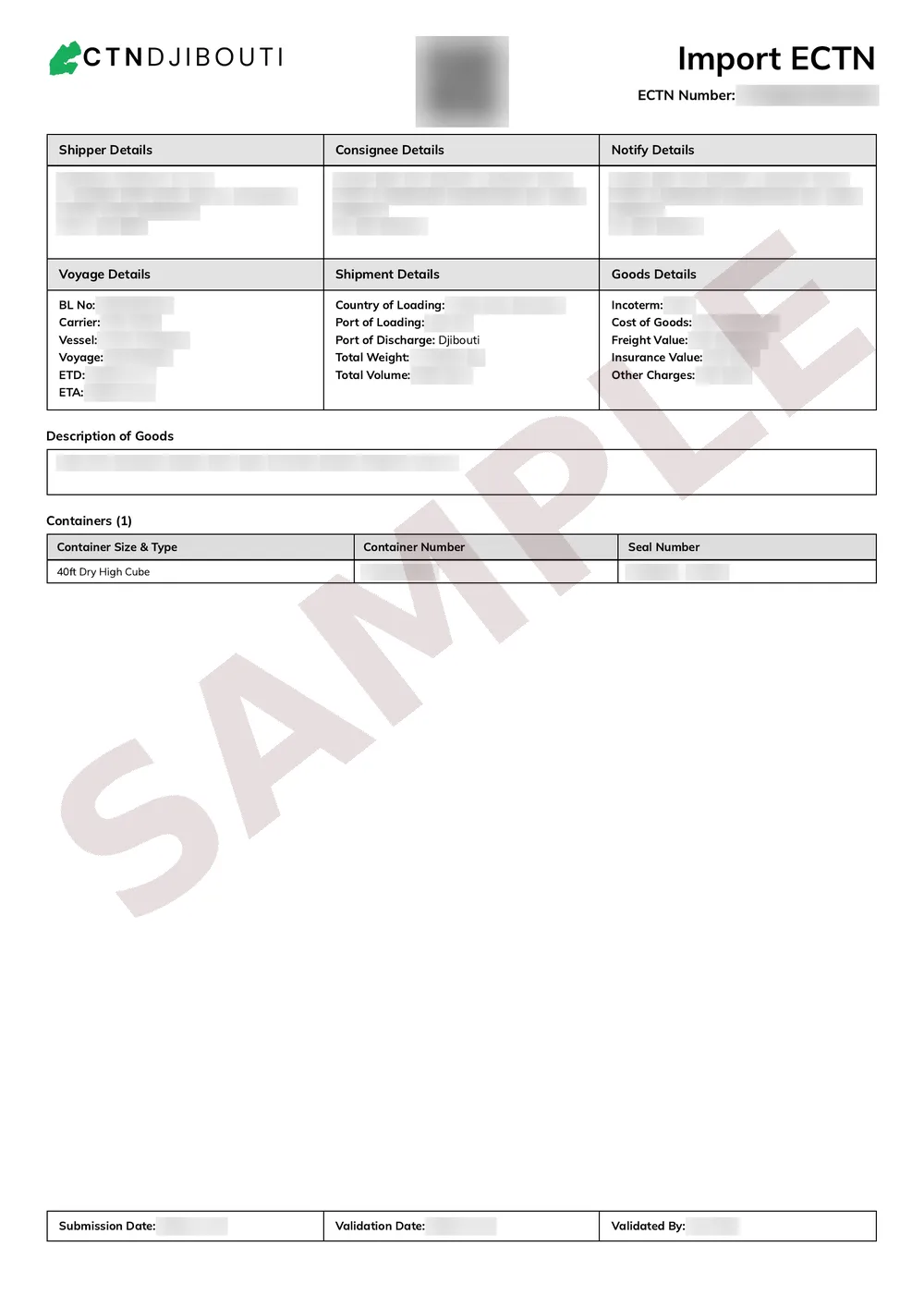
This is what a validated ECTN for Djibouti looks like once it is issued. Shipment details are blurred in the sample.
Common questions about the Djibouti ECTN, transit to Ethiopia and when to apply.
The Djibouti ECTN (Electronic Cargo Tracking Note) is the cargo tracking certificate required for cargo discharged at the Port of Djibouti. It records the shipment details before arrival so the cargo can be cleared in Djibouti or moved into the Free Zone.
Yes. ECTN and CTN are names used for the same cargo tracking certificate for Djibouti.
Not for direct transit. Cargo discharged at the Port of Djibouti and sent straight on to Ethiopia does not need an ECTN when the B/L shows “In transit to Ethiopia” and the consignee is in Ethiopia. Cargo cleared in Djibouti or entering the Djibouti Free Zone needs one. Tell us the final destination and the consignee, and we confirm what your shipment needs.
The shipper or its freight forwarder usually arranges the ECTN at origin and shares the validated certificate with the consignee in Djibouti. We handle the application for you.
The Bill of Lading (a draft is enough to start), the commercial invoice, and the freight invoice if freight is not stated on the commercial invoice. If your shipment needs anything else, we tell you in our quote.
As soon as the B/L draft is ready, and before the cargo arrives in Djibouti. Applying early avoids clearance delays at the port.
Cargo that arrives in Djibouti without a valid ECTN can face penalties, clearance delays and demurrage until the certificate is in order. That is why we recommend getting it before the cargo arrives.
Yes. Send us the B/L and shipment details and we check what can still be done for your cargo.
Your ECTN draft is usually ready within minutes of receiving your documents. The fee depends on the number and size of containers; send your request and you get an instant quote.
Transit cargo or a number on the B/L? Read our ECTN guide: 5 details that catch forwarders out →
Your destination is already selected. Add the shipment type and we reply with the fee and the documents needed.